Understanding Driving Test Faults (UK)
Driving Fault (Often Called a Minor fault)
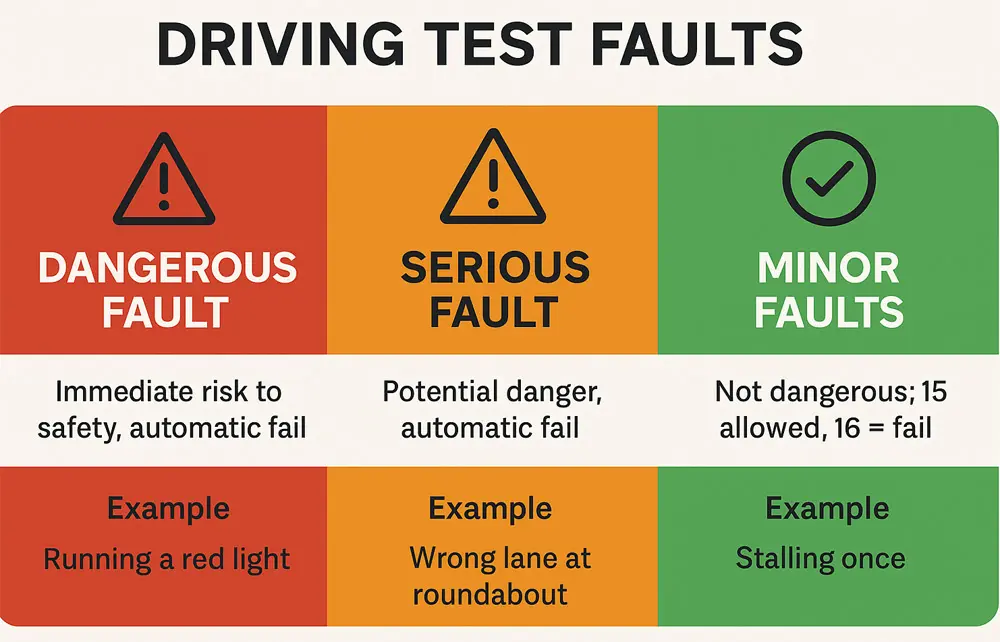
Definition, small mistakes that do not pose an immediate danger or risk, but show lapses in skill, control, or observation
Examples:
- Still in the car, but recovering safely
- Hesitating slightly too long at a junction
- Gear selection, slightly late or early
Impact
- You are allowed up to 15 minor faults
- 16 or more minor faults will result in a fail
- Too many minor faults in the same area can be marked as a serious fault
2. Serious Fault
- Definition of a mistake that could potentially be dangerous, or has a clear safety implication, even if no immediate danger occurs
Examples
- Poor observations at the roundabout, causing other road users to react
- Poor Lane, discipline
- Not giving away correctly at a junction
Impact
- One series fault will result in an automatic fail
- Shows a significant area of unsafe or poor driving skill
3. Dangerous Faults
- Definition a fault that has caused or could have caused, an actual danger to you, the examiner other road users, or property
Examples
- Pulling out into the path of an oncoming vehicle
- Ignoring a red traffic light
- Mounting the pavement, while driving.
Impact
- One dangerous fault is an immediate fail.
- The examiner may intervene or prevent an accident.
Key reminders
- Examiners want to see safe, competent, Driving.
- A single serious or dangerous fault and the test, even if everything else is good.
- Stay calm and focus on safety, observations, and good decision-making.
For more information regarding how a driving test is marked in the UK click on the link below
https://www.gov.uk/guidance/understanding-your-driving-test-result/car-driving-test