Common Driving Test Examiner Phrases (UK)
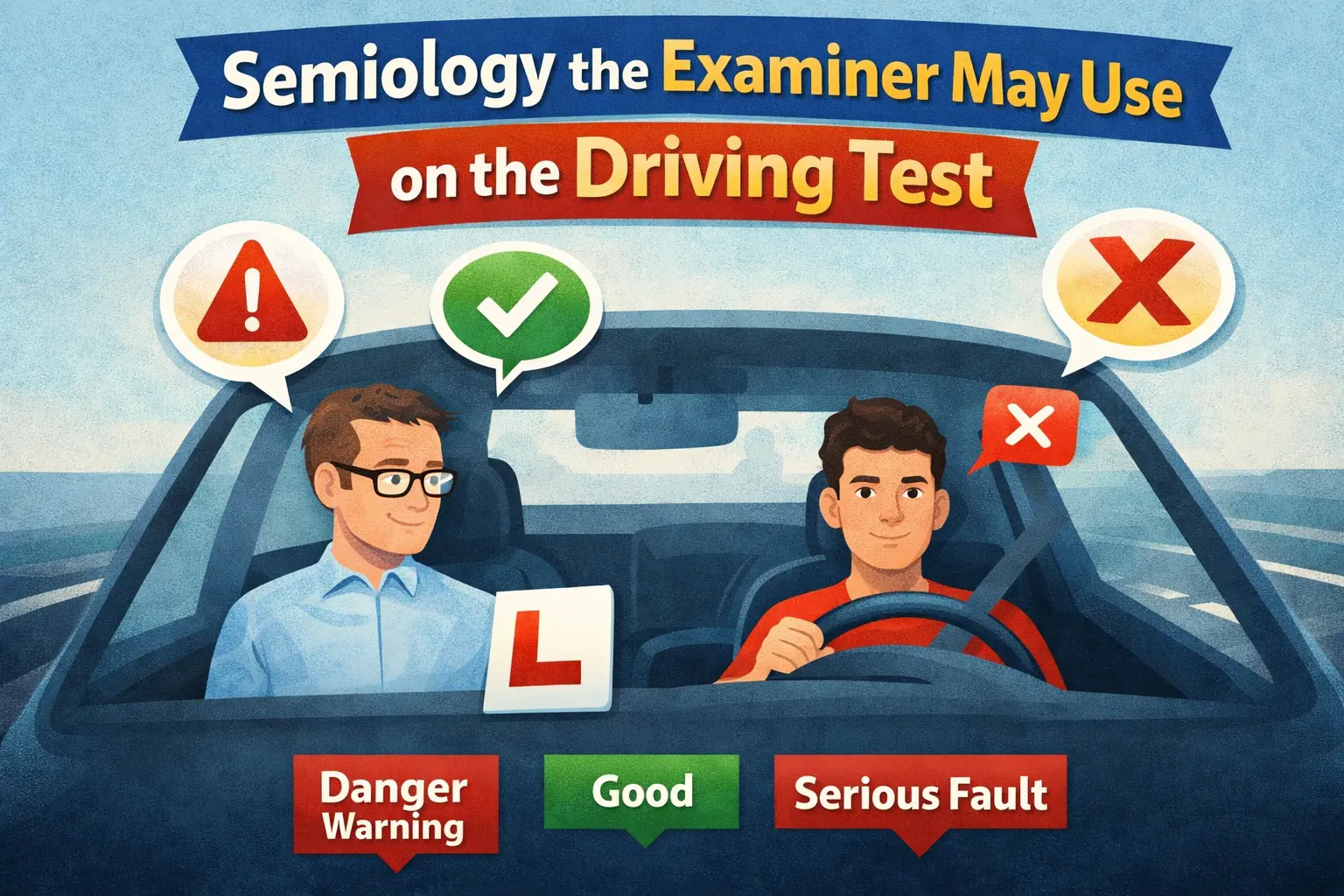
These are typical phrases used by a DVSA driving examiner during a UK practical driving test. Familiarising yourself with this language can help you feel more relaxed and prepared on the day of your test.
Start of the Test
“Hello, my name is … and I’ll be your examiner today.”
- “May I see your driving licence please?”
- “Could you read the number plate on that vehicle please? “
- “Before we start, I’d like you to sign the iPad.” (Your signature should be as close as it can be to the one on your licence)
- “If you follow the road ahead unless road signs tell you otherwise, I’ll give you directions.”
- “If I don’t say anything, please continue driving as normal.”
- “When you’re ready, drive on.”
General Driving Directions
“At the end of the road, turn left.”
- “Turn right at the next junction.”
- “Take the second exit at the roundabout.”
- “Follow the road ahead.”
- “Keep in the right hand lane.”
- “Move back to the left lane when it is safe.”
- “In about 300 yards, turn left.”
Directions are usually given well in advance and if you don’t understand anything even on the independent driving section ask the examiner to repeat the instruction.
Independent Driving Section
“For the next 20 minutes I’d like you to follow the sat nav.”
- “The sat nav will tell you where to go.”
- “If the sat nav stops working I’ll give you directions.”
- “Don’t worry if you go the wrong way, I’ll help you get back on the route.”
- “Please follow the signs for [destination].”
Manoeuvres
Reverse on the right side of the road
The examiner normally gives the instruction while driving along a suitable road. Typical wording:
- “I’d like you to pull up on the right-hand side of the road when it is safe to do so.”
- “Please stop on the right-hand side of the road.”
Once the car has stopped: - “Now I’d like you to reverse back for two car lengths.”
- “Keep reasonably close to the kerb.”
Sometimes they may add - “Take your time.”
After Completing the Manoeuvre:
They will say:
- “Thank you.”
- “When you’re ready, drive on when it’s safe.”
The reverse park (parallel park)
Typical wording: - “I would like you to carry out the reverse park exercise.”
- “Please pull up on the left behind the parked vehicle ahead.” Once stopped:
- “Now I’d like you to reverse back and park behind that vehicle.”
- “Try to finish within about two car lengths of the vehicle.”
- “Try to finish reasonably close to the kerb.” If clarification is needed:
- “Just reverse back and park behind the vehicle.”
If the Learner Stops too Far from the Kerb. - “You can adjust your position if you wish”.
After Completing the Manoeuvre:
They will say:
- “Thank you.”
- “When you’re ready, drive on when it’s safe.”
For the Forward bay park
- “I would like you to carry out the forward bay exercise.”
- “We’ll pull into the car park just ahead.”
- “Please drive forward and park in one of the empty bays.”
- “Try to finish within the white lines.”
Sometimes they add: - “You can choose any bay you like.”
- “You can straighten the car if you need too.”
Hints they may use are:
“Take your time.”
“Keep going.”
“That’s fine.”
The reverse bay park
The examiner usually explains the task clearly before you begin: Typical wording
- “I’d like you to carry out the reverse bay park exercise.”
- “Please pull forward into one of the empty parking bays.”
- “Then reverse into one of the empty parking bays.”
- “Try to finish within the white lines.” They may also add:
- “You may choose any bay you like.”
- “Take your time.”
Whilst reversing the examiner usually stays quiet allow the candidate two concentrate, but they might say - “That’s fine”
- “Take your time”
If clarification is needed: - “Just reverse into any of the empty bays.”
Learners are allowed to adjust their position if needed
The examiner might say - “You can correct the position if you wish.”
Emergency Stop
The examiner prepares the learner first so they know it may happen:
Typical wording
- “At some point during the drive I’ll ask you to carry out an emergency stop.”
- “When I give you the signal, I’d like you to stop the car as quickly and safely as possible.”
- “Before moving off again, make sure it’s safe all around.”
When the examiner decides to carry out the exercise they will raise their hand and say: - “Stop.”
Sometimes it might be slightly longer: - “Stop please!.”
The signal is usually a raised hand combined with the verbal command.
After the vehicles is stopped:
The examiner normally checks observations allowing the learner to move off. They may say
- “Drive on when you’re ready.”
- “When it’s safe, continue.”
End of the Test - “That’s the end of the test.”
- “I’m pleased to tell you that you’ve passed.”
- “I’m sorry to tell you that you haven’t passed today.”
- “ Let’s go through your faults.”