Pedestrian Crossings: Types, Tips, and Safety Information
Pedestrian Crossings: Types, Tips, and Safety Information
1. Zebra Crossing
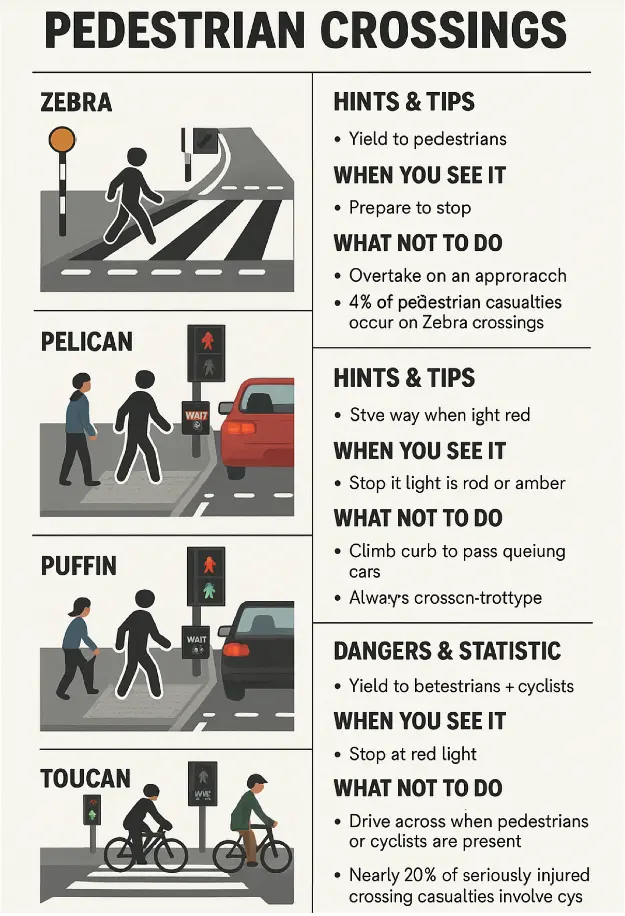
Appearance – Black and white stripes with flashing, amber beacons.
When you see it: In urban areas near schools and shops.
Hints and Tips:
• Slow down and prepared to stop for pedestrians waiting to cross.
• Pedestrians have priority once on the crossing.
What Not to Do:
• Do not overtake the vehicle nearest the crossing.
• Avoid speeding even if no one appears to be waiting.
Dangers & Statistics
• 4% of pedestrian casualties occur at pedestrian crossings.
• High risk in poor visibility or when drivers fail to slow down.
2. Pelican Crossings (Pedestrian Light Controlled)
Appearance: Traffic lights with ‘WAIT’ box and pedestrian signals. When You See It: Near busy intersections or in shopping areas.
Hints & Tips:
• Stop when lights show red or flashing amber if people are crossing.
What Not to Do:
• Do not drive off while pedestrians are still crossing.
• Never Block the crossing.
Dangers & Statistics:
• 7% of pedestrian injuries involve misinterpreted light-controlled crossings.
3. Puffin Crossing (Pedestrian User-Friendly Intelligent)
Appearance: Similar to the Pelican but uses sensors.
When You See It: In towns and cities.
Hints & Tips:
• Lights change based on pedestrian presence.
• Pedestrian signals are next to the push-button.
What Not to Do:
• Do not assume people have crossed just because the lights change.
Dangers & Statistics
• 6% of pedestrian casualties still occur at signal-controlled crossings.
4. Toucan Crossings (Pedestrians & Cyclists)
Appearance: Wider crossings with pedestrian and cyclist signals.
When You See It: On cycle paths or shared spaces.
Hints & Tips:
• Stop at red light for both cyclists and pedestrians.
• Watch for both pedestrians and cyclists.
What Not to Do:
• Drive across when either group is present.
Dangers & Statistics:
• 20% of serious injuries at crossings involve cyclists and vehicles.
General Safety Reminders:
• Reduce speed when approaching any crossing.
• Stay alert for sudden pedestrian movement.
• Use extra caution at night or in poor weather.
• Don’t rely solely on pedestrian signals-check the area thoroughly.